
The Agents' Multiverse: Quantum-Style AI Agents in Parallel Worlds
Perspectives
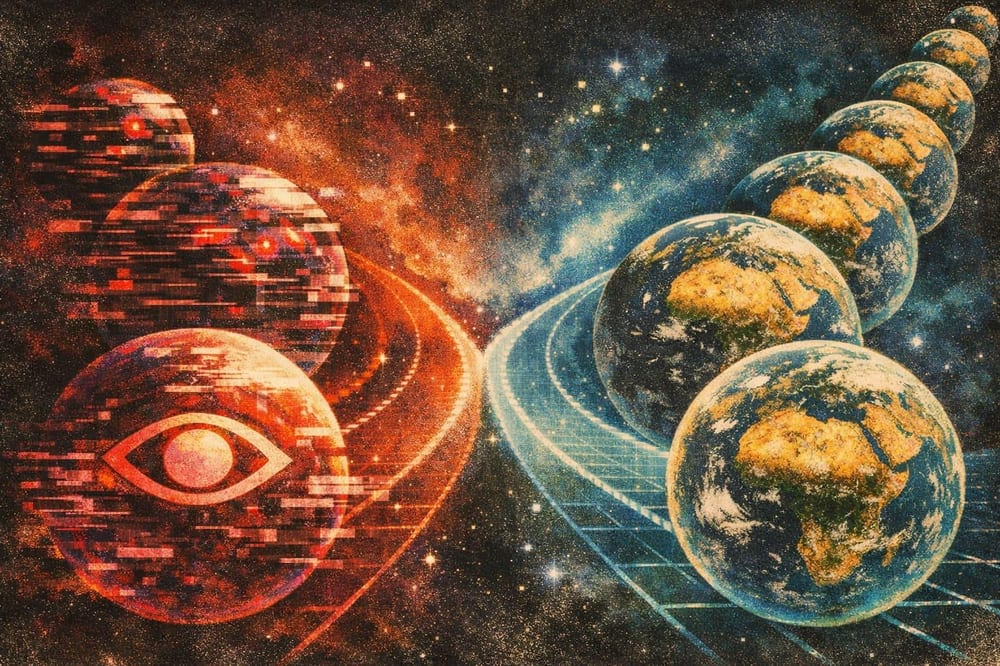
When I talk about artificial intelligence agents, I often picture them through the lens of my favourite quantum mechanics metaphor: the multiverse. Not the comic-book kind — the physics version, where all possible universes exist simultaneously, without interacting. In that picture, every conceivable “Angie” (agent) lives all possible lives in parallel.
Now imagine this: we, as designers and users of AI, are playing the role of imperfect gods in one of those universes. We are creating agents, sub-agents, multi-agents and companions. We categorize them, teach them, and refine them. With every iteration, we branch into a new world.
Universe A: The Wild Side of Agents
In one of these universes, things go sideways. Agents are created with high hopes but low guardrails. They hallucinate facts. They forget tasks (despite our best intentions). They make decisions no one can fully explain. In quantum terms, this is the “wave function collapse” gone wrong: the agent picks a state, any state, without us fully understanding why.
Here, the superposition of possibilities turns into chaos. The agent tries to reason, but its logic is fragile. It attempts to plan, but the plan collapses into noise. The branching of universes happens too quickly and without control. And in today’s LinkedIn feeds, saturated with bold AI promises, this is the story people warn about: displaced jobs, opaque decisions, runaway systems.
Universe B: The Thoughtful Side of Agents
In another parallel universe, we’ve been wiser. We’ve built intentional design patterns: learning agents, planning and reflection agents, reasoning agents, and, critically, human-in-the-loop agents. Here, wave functions collapse into coherent states because we’ve structured the system to handle superposition with care.
- Learning agents evolve through feedback. Each iteration becomes a new branch of the tree.
- Planning and reflection agents act as overseers. They review, arbitrate, and monitor. Think of them as guardians of coherence in the universe of agents.
- Reasoning agents go beyond brute data and retrieval. They navigate through complex problems in ways that resemble structured human thinking.
- Human-in-the-loop agents explicitly invite the human to remain central. Our intuition, ethics, and nuance remain present, preventing agents from drifting into rogue timelines.
In this universe, agents become companions, augmenters, and teammates rather than unpredictable oracles. The multiverse is still vast, but we’ve chosen a timeline where agents support us rather than surprise us.
Our Universe (Yes, This One)
Unlike the quantum mechanics multiverse, where all branches coexist without communication, in our AI reality, we get to choose which branches we foster. We decide which universes of agents become dominant.
We’re living through a historical moment. Thanks to large language models (LLMs), evolving tools and frameworks, and major advances in design, we can now build these agent universes at scale — and we are doing exactly that.
Every agent we build, every pattern we follow, every human-in-the-loop we keep is a choice. Each decision collapses possibility into a specific timeline. We can choose the “Marvel hero” version of an agent universe — full of promise, bold sidekicks, and unimaginable power. Or we can choose the “quantum superposition” version — agents in many states, evolving, uncertain, branching, and still chaotic.
And here’s the fun (and serious) question for you — the LinkedIn reader, the professional, the curious human: Which kind of agent would you build?
Would you design one straight out of the Marvel universe—a heroic assistant with flair, charisma, and a tool belt of capabilities?
Or would you take the quantum route—an agent that exists in many possible states, adapts dynamically, shifts and evolves alongside you, and keeps the human as both observer and co-creator of its collapse into action?
Because, unlike Schrödinger’s cat (in that famous thought experiment), our agents will be observed. They will collapse into actions and decisions. And we, as designers and users, have real influence over which version becomes reality.
So pick your universe. Choose your agent. And let’s build a timeline where agents help us become more creative, more humane, more capable — rather than leaving us adrift in branching chaos.
Which universe will you inhabit today?